
Therapy Dog Resources for Teachers
Welcoming a therapy dog into your classroom is a truly special experience — one that inspires confidence, curiosity, and joy in young learners. To help you make the most of your visits, we’ve gathered a collection of practical resources, from classroom forms and activity ideas to professional literature which highlight the proven benefits of incorporating therapy dogs into the total curriculum.
 Request For Therapy Dog Form – teachers
Download and complete this form to request a therapy dog for your classroom.
Introductory Letter to Parents – sample
Utilize this letter to request parent permission for a child to participate with a classroom therapy dog.
Let us know how therapy dogs have impacted your classroom.
There are many articles available on the internet about using therapy dogs in the educational arena. Here are a few several which we found to be very informative:
Magic Formula Concepts on the keys to using therapy dogs successfully in the educational environment
Dunlap – Canine-Assisted Therapy A PhD dissertation project conducted to review related literature and examine the effects of canine assisted therapy on remediating reading skill deficits and its impact on attitudes towards reading
Canine Visitors The influence of therapy dogs on young children’s learning and well-being in classrooms and hospitals
Literacy and TD How a therapy dog may inspire student literacy engagement in the elementary language arts classroom
Social Effects of Therapy Dogs on Children with Disabilities Research to assess the effects of the presence of a dog on verbal and non-verbal interactions of children with developmental disabilities in a school classroom
Therapy Dogs & Best Practices in Reading R.E.A.D. research results on the impact of therapy dogs in the educational environment
ACTIVITY IDEAS
MAKE THE MOST OUT OF YOUR THERAPY DOG
Hopefully these ideas will serve as a springboard for your own creative ideas to maximize the presence of your therapy dog. The generic name *ROVER* has been used where you can substitute the name of your therapy dog. Where appropriate, the state standards have been noted to demonstrate how the activities can be tied into your curriculum.
Remember, your creativity is unlimited in ways to use the therapy dog. Always discuss your ideas with the handler first to be certain that the activity is acceptable for the dog’s welfare.
BEHAVIOR MANAGEMENT
Instead of using a stoplight, use puppies. Move them out of the doghouse for a warning, and further and further for each infraction.
Use dog dishes or pockets for a behavior chart. Put a series of bones in each one. Title: NO BONES ABOUT GOOD BEAHVIOR. Earn bones for good behavior and task persistence. This theme can also be used with student helpers who are called WATCH DOGS. ~ Acquire “golden tokens” from the Crayola Factory. Students with behavior issues can earn golden tokens for extra time with their therapy dog. (Carla Foy – Richboro Elementary)
BLOG
Have a ROVER BLOG where students can share the books they are reading in class or for their therapy dog visit – a great idea for writing practice and to discuss books.
BULLETIN BOARD
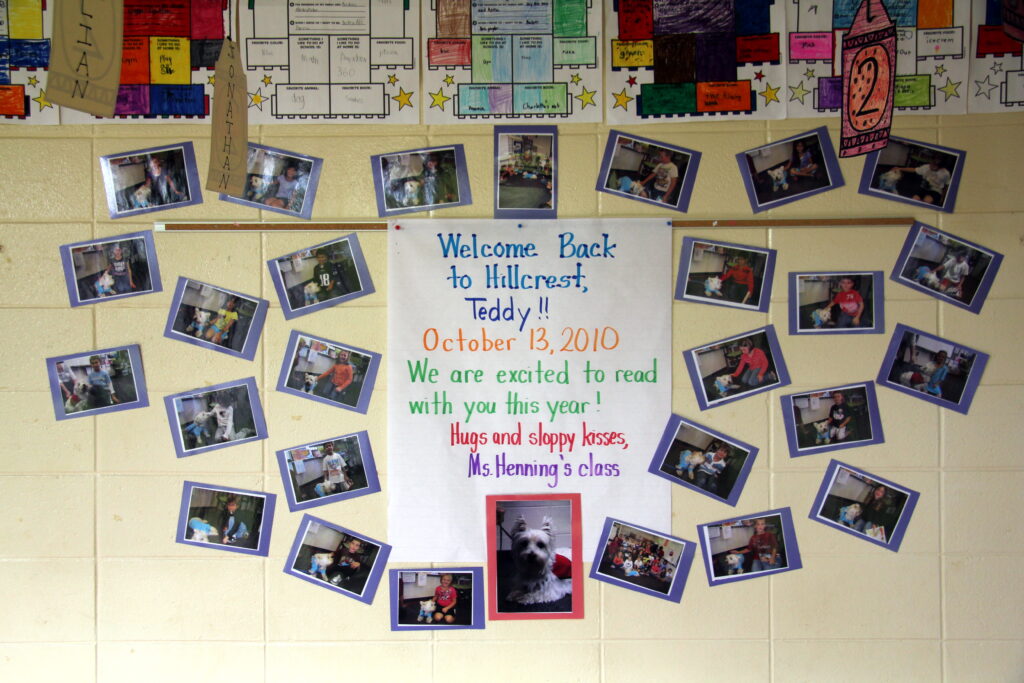
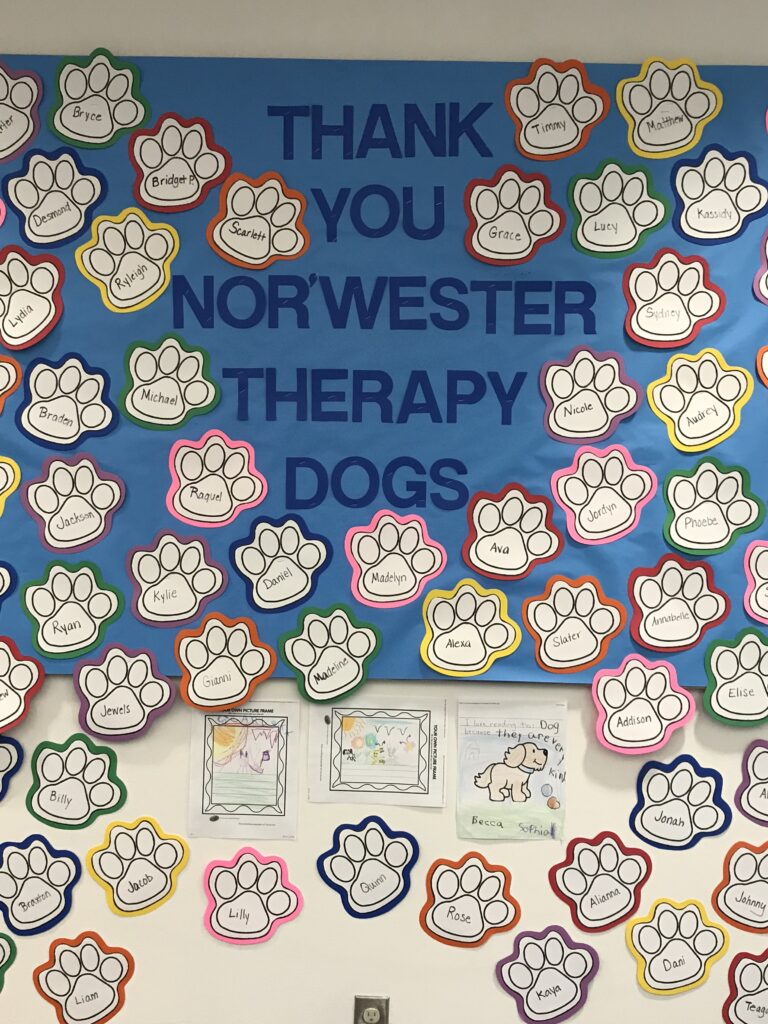
Make a big doghouse and put a bunch of little puppies with the students’ names on them. “A DOGGONE GOOD CLASS.” Don’t forget to add pictures from your “dog visit”.
Use dog themed fabric to cover a bulletin board. Some ideas are LEASH LAWS for classroom rules – FIRED UP FOR THIRD GRADE with a large dog and fire hydrant.
PAW PRINTS
Print out large paw prints and put them on the floor of your room or up the wall. Write book titles on each paw print to show how many books the children have read during a marking period or for the year.
ORAL SKILLS
Have the children read aloud to the therapy dog for 10 to 15 minutes. CC standard 1.1.E (Speaking Gr. K-5) CC. standard 1.1.E (Gr. K-5 Reading)
Have a student take the handler and TD to another class to introduce them to the teacher and children and tell the class about the dog. This is a good time to share rules for approaching the therapy dog and handler in the hallways.
** IMPORTANT NOTE: Allergy clearance and administrative approval must be done before going into another classroom CC standard 1.5.D (Speaking Gr.K-5)
Have a Young Author Day and have each child read their story or poem to the class. Invite parents and the principal.
CLASS REWARD
Add spots to a big dog to work towards a class reward. ~ On a bulletin board post the title ROVER’S BUDDIES. Pin paper bones around a picture of the therapy dog with each child’s name on a bone. At the end of the day any student who got in trouble or forgot homework, etc. will turn their bone around so their name is not showing. At the end of the week the teacher collects all bones with the names still facing forward and put them into a bucket. One to three bones are drawn, and those students get a reward. It can be extra time with the therapy dog or an item from the prize basket.
ROVER TROPHY AWARD given in January and June for 85% (or whatever percentage you want) for attendance, work habits, and behavior, etc.
GAMES: ~Make up ROVER WORD GAMES as a way to learn new words and to develop a larger vocabulary.
ROVER FLASH CARDS can serve as reading remediation – word recognition.
THERAPY DOG BINGO: Make bingo cards with 25 words/pictures/symbols related to the class therapy dog. Small dog treats can be used to cover the squares as the word/picture/symbol is called.
STUDENT OF THE WEEK/MONTH
Make a banner that reads A STUDENT TO BARK ABOUT and put information about that student below the banner. Perhaps the student of the week or month could then do something special with the therapy dog. The handler will determine what is appropriate.
Student of the week or month can be TOP DOG OF THE WEEK / MONTH. WRITING: CC standard 1.4 .A and B (Gr. K-5)
Have the children write stories or poems about their therapy dog.
Children can keep a ROVER JOURNAL or DIARY to record thoughts about books they have read to the therapy dog. Teachers can come up with their own requirements for what needs to be recorded in the journal or diary.
MAKE YOUR PET A STAR — Have the children bring in a picture of their pet and write a story about their pet. It can be imaginary or something that actually happened. If they do not have a pet, have them bring in a picture of an animal about which they would like to write.
LIBRARY
Allow one or two students to go to the library with their therapy dog to select books they would like to read to the dog or books for personal enjoyment which they can write about in their journal or diary.
**IMPORTANT NOTE: Therapy dogs are not permitted to go into other classrooms without prior approval from the principal, and they must have an escort.
MATH & MEASUREMENT
Use the therapy dog to develop measurement skills. Students can measure the dog’s neck, body length, tail length, height, leg length, etc.
Graph what kind, and/or how many pets your class has. Older students can survey other classes (or whole school).
READING CORNER
Create a cozy reading corner and name it after your therapy dog – i.e. ROVER’S POUND, etc… Add some fun pillows and stuffed dogs. Encourage students to bring in photos of their dogs and post them on the wall.
WRAP YOUR PAWS AROUND A GOOD BOOK
Set up a basket of “dog” books which students can choose for independent reading. The books have been read in class or introduced (book talked) to the students – they must be centered around dogs. These books are hot items – in great demand among the students. Sometimes a student will request that a certain book is added to the basket. (Carla Foy – Richboro Elementary)

RESEARCH
CC standard 1.4 .A and B (Gr. K-5 ) Writing CC standard 1.5.D (Gr. 3-5 Speaking)
Have the students research their therapy dog’s breed. If the dog is a mixed breed, the handler will tell you what breeds are most likely in the dog’s bloodlines. The students can then research those breeds. Be certain to lead the research by giving the students specific facts to locate. (i.e. How did the breed originate? What is the breed standard? (color, size, features) etc… Share with class.
WEBSITES
Teaching ideas and lesson plans on websites often serve as springboards for your adaptations to fit your students and class. Here are a few that are particularly good. Be aware that URLs change and disappear. These sites are provided simply as good examples.
Reading Rockets: Teaching kids to read and helping those who struggle

